This is occurring more often in the luxury and ultra-luxury markets

Wedding Pro Q+A
This question is from a luxury wedding videographer:
Hi Liene,
Back in February I was booked for a September wedding with a planner I'd been hoping to work with for years, one of the big names in the luxury market.
Last week the couple let her go and hired someone else. When I mentioned it to a few industry friends, I found out that several of them have had couples fire their original planners recently too.
I was really surprised by the names of the fired planners. All of them have been around for a long time and aren’t newbies. Some of them I know personally and they’re really nice and seem really successful.
So my question is, why is this happening? Are all these planners really that bad?
Answer from Liene:
First things first: yes, wedding clients are firing their wedding planners more often than they did in the past. (They’re also firing other vendors as well.)
And yes, this is happening more at the high-end of the market than at the lower-end.
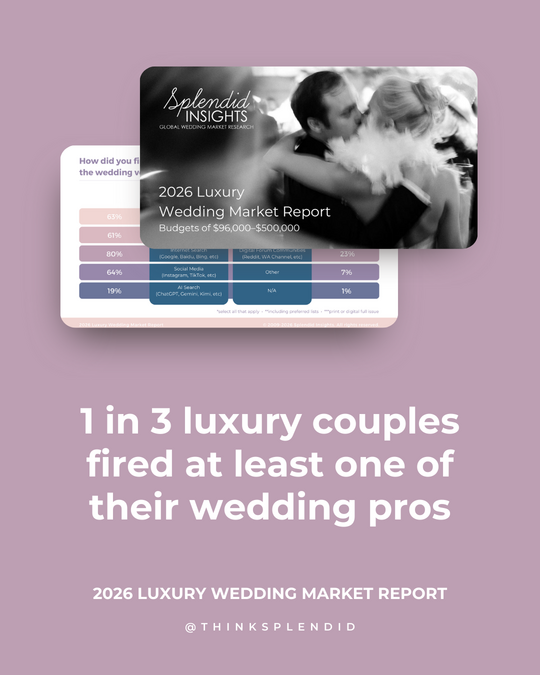
The 2026 Wedding Market Reports from Splendid Insights (a company I founded in 2009 as a sister company to Think Splendid that conducts unbiased global wedding market research) prove this:
Last year, 15% (1 in 6) of wedding couples globally across all budgets fired at least one of their wedding pros.
31% (about 1 in 3) of couples in the luxury wedding market segment (budgets of $96,000-$500,000) fired at least one of their wedding pros last year and only 15% of luxury couples would hire their planner again if they could do their wedding over.
27% (just over 1 in 4) of couples In the ultra-luxury wedding market segment (budgets of $500,000+) fired at least one of their wedding pros and only 17% of ultra-luxury couples would hire their planner again if they could do their wedding over.
There’s no sugarcoating the fact that these are dismal numbers. Fortunately, they are fixable.
Let’s dive into what’s caused this shift in the wedding industry and — more importantly — how to solve it:
Reason Luxury Wedding Planners Get Fired #1: It’s Actually Not the Planner’s Fault
Sometimes when a wedding planner is fired, it’s through no fault of their own. A few examples of circumstances where this happens:
The couple changes their mind on holding a larger event and elopes instead.
The couple breaks up and calls off the wedding.
A family member dies and the couple decides to cancel the wedding instead of postponing it.
The couple’s (or their family’s) financial situation changes drastically and they can no longer afford the level of event they were initially planning.
A couple fires a different vendor and decides anyone they referred is also getting the boot simply because of guilt by association.
The client is absolutely nuts and fires the planner even though the planner did everything 100% correctly.
While this last example does happen, it does not happen as often as planners claim. Usually there is something the planner could have done better (or better communicated) that would have prevented the situation from escalating. More on this below.
Reason Luxury Wedding Planners Get Fired #2: They Have a Personality Clash With Their Clients
The Problem
Sometimes wedding planners get fired because of a personality clash with their clients. This is one of the examples of a situation that can seem like it can be blamed squarely on the client but is in fact usually preventable by the planner.
The point of your sales and marketing process is not just to attract and book the weddings, it’s also to evaluate potential clients to see if they are a good fit with your personality.
Splendid SolutionS
Make a list of 5-10 of your all-time favorite clients (not necessarily favorite weddings):
ASK: What did I like about the character of the couple and any other people from their group I worked directly with (parents, siblings, friends, the couple’s in-house staff, etc) during the planning process?
Because you’re focusing on character traits here, answers like “they were wealthy enough to afford me” don’t count.
Circle the favorite character traits that come up the most across your 5-10 clients.
2. Do the same for a handful of clients that you liked working with the least (hopefully this list won’t include 5-10 clients, but if it does, that’s info you can use as well).
3. Look at your marketing copy on everything from your website to your social media posts to your inquiry response emails.
Identify where your own words reflect the positive character traits you’ve identified as the top among your favorite clients.
Identify where your own words reflect or reinforce the negative character traits you’ve identified as the top among your least favorite clients.
If you find that your copy aligns more with the traits you dislike most in clients, then I’m sorry to tell you that you’ve been attracting clients with a vibe similar to what you put out. Rewrite your website and email copy and then change your Instagram, etc caption messaging going forward.
SPLENDID TIP: this is a task where AI can be a useful tool. Upload the copy you’ve collected to Claude, ChatGPT, etc. Tell it to be brutally honest and then ask it if your copy aligns with the positive. Then ask if it aligns with the negative. If it’s neither, ask it to identify which character traits or values are coming across in your own marketing writing.
4. During your inquiry meetings or calls, pay attention not just to what potential clients say, but to how they say it. This will give you clearer insight into whether or not they align with the values you hold.
Are they immediately dismissive of what you — or worse, their partner — has to say?
How do they affirm or shoot down any initial ideas you share? Is it kindly or with derision?
If they’re sharing what they liked/disliked about a friend’s wedding, do they focus just on how they felt about the concept in question or do they take it further and talk sh*t about the friend? If they talk that way about their friends to a stranger — because you are still essentially a stranger to them at this point — they will definitely talk about you that way.
How do they react when you explain that one reason you’re more expensive is because you pay your team members a living wage?
How do they react when you explain that the level of event they’re initially envisioning will require more staff to produce which will make the overall budget go up?
When you present your sample historical averages budget, do they argue about line items that include vendor meals or providing an “employee break” area for a week-long tent build-out?
On a lighter note, but still important to see if your personalities will mesh: do they laugh at your jokes? Do you laugh at their jokes? A similar sense of humor goes a long way during the wedding planning process.
5. MAKE A REFERRAL: If you can tell from the first inquiry calls that this client is not a good fit for you because of certain personality traits — mere differences, not the client being a truly evil person — refer them to another planner who might click better with them.
It’s important to remember that you’re not looking for perfection here. Every human being is a work in progress and we all have issues. No potential client arrives in your email inbox with zero problems or quirks, having graduated therapy, ready to blindly trust you completely, no questions asked.
Instead you’re evaluating whether or not you and this couple can work together in a way that leaves you both feeling happy and fulfilled.
There’s an old saying in sales, “It doesn’t get better than the first meeting” and 99% of the time it proves true.
It can be hard to turn down money from potential client, especially if you really need it. But if they come with a parade of red flags at the beginning, it’s a solid bet that things are only going to get worse as time goes on.
Worse, you might still be out that money anyway if they fire you and you end up having to return the retainer you thought was non-refundable.
Unfortunately, having the phrase “non-refundable retainer” in your contract does NOT automatically mean your retainer is legally non-refundable.
This is especially true if your retainer is 50% of your full fee. To keep that money, most courts will want you to either prove you have already performed at least 50% of the work the full wedding would have required or they will want you to prove that blocking off the wedding date on your calendar caused you to lose other business you could have booked instead.
Reason Luxury Wedding Planners Get Fired #3: They’re Bad at Managing Money
THE PROBLEM
The planner uses a pass-through model to manage the wedding budget even though they are personally bad at managing money. This combination results in mismanaged wedding budgets and angry clients.
Pass-through is a method of the client paying the planner the full amount of the wedding budget and then the planner paying vendors on the clients’ behalf.
There are many benefits to using a pass-through model for both a planner and a client, especially if you work with UHNW clients whose payments are sent by their Family Office which will have its own set of accounting and approval processes. In these instances, a pass-through model streamlines the red-tape a vendor might have to go through to get their invoices approved and paid.
The problem is that while some planners can manage every penny flawlessly, many can not. They often end up with one client’s funds commingled with the budget funds of their other clients as well as with the planner’s own business revenue.
If the planner’s waiting on a wire from one client but needs to pay an invoice belonging to another, they might end up “robbing Peter to pay Paul” — using money from one client to pay an invoice on behalf of different client — resulting in accounting confusion and, in some cases, fraud.
Sometimes a planner in this situation will call me to help them fix things, but most planners instead just get overwhelmed, feel afraid to ask for help, and end up in a shame spiral that just makes the problem bigger.
Another issue is that legally a planner can’t just decide they’re going to use a pass-through model and start accepting and paying that money through their business bank account. In the US, to accept payments from clients and then disburse those funds to vendors, you generally have to do one of two things:
Your fee is the entirety of the wedding budget and the client only signs one contract — yours. You then truly act as a subcontractor — signing every single vendor’s contract naming yourself (the planner) as the client and yourself as personally responsible for all money due.
This method is a huge liability and using it ended up screwing over several big name planners during the Madoff scandal and the crash of 2008.
You have to be registered as a licensed money transmitter. (I do not know a single wedding planner who uses a pass-through model who is.)
Splendid SOLUTION
If you know that a pass-through model is the best method to both reduce your clients’ stress and to deliver the caliber of full-service customer service your brand is known for, I recommend partnering with WedWallet, a wedding FinTech company that is legally compliant.
With WedWallet, your client sends their lump-sum wedding budget payment to WedWallet (family members can also contribute their share of payments via a special link). Then WedWallet handles sending each vendor their payments on the date each respective invoice is due.
As the planner, you have access to see all the invoices uploaded and status on what’s been paid and what’s still due without the hassle or liability of having to actually handle the money yourself.
This allows you the ability to offer a pass-through model while outsourcing the admin (and legal compliance) to WedWallet. It’s also free for planners.
I don’t say this lightly — WedWallet is truly a gamechanger for the wedding industry.
You can learn more about WedWallet here and follow them on Instagram here.
Reason Luxury Wedding Planners Get Fired #4: They Manage Money Unethically
THE PROBLEM
A wedding planner being bad at managing money in general (see #3 above) is different than a wedding planner intentionally managing money unethically. The first is a skill issue, the second is an intentional decision to defraud a client.
Some real-life examples where wedding planners have intentionally defrauded a client include:
Billing a client for custom-designed fine china and providing tableware from DollarTree instead.
Purchasing Hermès and Chanel handbags for themselves and billing it to clients through an ambiguously labeled line item like “Misc. Decor.”
Photoshopping invoices from vendors to show a higher price due and then personally pocketing the difference.
Hiring 15 freelance staffers and billing the client for 20.
Accepting undisclosed kickbacks from vendors. (You can read more about the difference between legal commissions and illegal kickbacks here.)
Marking up a vendor’s retail pricing when you already charged the client a percentage of that vendor’s fee.
SPLENDID SOLUTION
Knock it off. You’re giving the entire wedding planner profession as well as the larger wedding industry a bad name.
If you can’t make the money you need to from your pricing alone, you need to fix your business model.
Reason Luxury Wedding Planners Get Fired #5: They’re Not Transparent in Their Billing
THE PROBLEM
A planner’s pricing or billing lacking transparency is a problem across the board in the luxury and ultra-luxury wedding industry.
In fact, only 7% of ultra-luxury couples (wedding budgets of $500,000+) and 11% of luxury couples (wedding budgets of $96,000-$500,000) who married last year said their planner’s pricing and billing were transparent.
If you are a planner who charges a high design fee (this is the value-based payment for getting access to you as an artist and the creativity you’ve honed over a lifetime, not the cost of producing the event) and then bills production costs or charges a percentage of the total wedding budget as your fee, this lack of transparency becomes an even bigger issue.
There is nothing wrong with charging a design fee or using a percentage pricing model but the key to getting clients to trust that you are not just recommending and booking more expensive vendor options to drive up your own revenue requires being super transparent in both your buying and billing processes.
SPLENDID SOLUTIONS
1. Make it clear to your clients that they have final approval on any budget created, vendor booked, product purchased for their wedding, or spending that exceeds the scope of the initial budget.
Get this approval in writing every single time, either with an actual signature on a change order or by following up a phone call with an email recapping any changes or product approvals they agreed to.
NO VERBAL AGREEMENTS. Never, never, ever! Multiple planners have had to sue clients after the wedding for non-payment when the client conveniently forgot about agreeing to something. And those planners did not always win those lawsuits, even though in many cases they were legitimately in the right.
This has gotten especially messy when the planner used a pass-through model and fronted the money to pay for vendors and products that the client verbally agreed to add.
You can also consider having your client sign an agreement authorizing you to spend up to $X amount for their wedding without specific pre-written approval that they will then reimburse you for.
This would be for things like coming across the perfect shade of pink scarves at a random flea market that you’ll use for the gift bags to needing to hire someone to paint over an unexpected eyesore the day of the wedding (one planner I know showed up to her event on a lake to find that the out-of-town next door neighbors had installed an ugly dock that would be in the background of the photos, so she immediately hired someone to paint it.)
2. For more transparent billing, one option is to use Preston Bailey’s method (which he’s talked about publicly) where he charges a substantial design fee and then bills for production costs by line-iteming every single product and piece of equipment used to bring his creative event concepts to life.
If constructing an installation requires 476 0.25-inch Phillips-head screws, he includes that as a specific line item in his client-facing billing. The cost of the screws is not buried in a catch-all concept line-item called “Wedding Reception Canopy.”
If you’re creating a proprietary product for a client where itemizing the exact materials used would reveal a trade secret, then Preston’s method is not the best fit. For this, a concept line-item would work better, but that means you will have to be extra diligent in building trust with your client through other areas.
Reason Luxury Wedding Planners Get Fired #6: They Make Their Clients Feel Like a Number
THE PROBLEM
It is Human Nature 101: no one wants to feel unimportant.
This is especially true when an ultra-luxury wedding client is paying their percentage planner a 6-, 7-, or even 8-figure planning fee on their even larger wedding budget.
Some of the real-life reasons couples have told me their planners made them feel like a number include:
Signing a contract with a planner who owned the company and then only finding out afterward that the owner wouldn’t be the one they were working with. (And no, the contract made no mention of this.)
Being told they’d work with a lead planner but that the owner would still be actively involved in their event — and then that not happening.
Never being able to talk to the planner when they called the office.
Planners showing up to meetings with decks and materials for a different client instead of theirs.
The planner telling them that their wedding is just one of many she has and that she can’t focus on them until six months later.
Hearing the planner talk excitedly about another client’s larger budget wedding and never receiving that level of excitement from the planner about their own.
Planners getting snippy when a client doesn’t like a particular idea and saying all their other clients trust them, so they should, too.
SPLENDID SOLUTIONS
1. If you use an associate planner or agency business model, make it clear up front who the client will be working with.
If you personally handle the initial interviews and sales meetings, include that planner in one of the initial inquiry meetings.
If a client books before you’ve met them, I recommend following up with a personal call welcoming them as a client. Reiterate your level of involvement and let them know which meetings they can expect to see you at. Do not rely on them knowing or remembering this info just because its in their contract.
2. Their time with you is their time with you. Protect it.
Do not refer to other events you’re currently working on during your client meetings.
If you mention a past event, it should be in the context of referencing your expertise (you know the venue’s offered generators aren’t powerful enough you’ll need to rent better ones), not you going on and on about how much you loved the client (or how much you loved their budget).
If the client asks about another event they saw on your Instagram or another wedding they attended of yours as a guest, then of course talk about it. But let them bring it up first.
3. Take an honest assessment of your capacity and adjust where needed.
The average wedding takes 200 hours to plan. That is the average wedding, not a big budget logistically complex destination production with a team of vendors operating out of multiple time zones. If you’re too busy to work on a client’s project beginning when they hire you, it means your business does not have the capacity you think it does.
Start by tracking your time on each and every task you do using toggl or another app. Have your employees do the same.
When I ask clients to do this, we often find that they have grossly underestimated how long a task actually takes them (for example, assuming a particular task takes 40 hours when the reality is closer to 60).Once you know how many hours the types of weddings you book actually take to plan and produce, map those hours against the available hours in a work week.
If you book 10 weddings per year, how many employees do you need on your team to make those weddings happen? How might you need to change your business model in order to generate the revenue you need to hire more people?
A Splendid Note: Capacity planning is something I consult on, so reach out if you decide you need help in this area.
Reason Luxury Wedding Planners Get Fired #7: They Under-Communicate
THE PROBLEM
Communication is an area where every type of business owner can improve, myself included.
When it comes to an engaged couple’s frustrations with their wedding planner, it’s usually because:
It’s unclear which tasks their full-service planner handles and which still fall on them (creating the guest list, etc).
Their planner seems to have a different definition of “full-service” than their friend’s planner.
They don’t know when deadlines are or what to do, when.
They’ve waited weeks for vendor recommendations yet the planner is posting the FAM trips they’re attending non-stop on Instagram.
Their planner provides vendor recommendations with no explanation on why they chose those particular companies or why they’re a fit for the couple.
They’re given price quotes with little explanation of what’s included or why one of the recommended vendors is so much more expensive than another in the same category.
When they ask specific questions about the planner’s process, they’re given a generic “Don’t worry, it’ll all be fine.”
SPLENDID SOLUTIONS
1. Set expectations up front by giving your clients an easy-to-read schedule of your planning process, customized for their wedding.
Include milestones and dates when they can expect certain things to be done.
Include deadlines they need to get things to you (their guest list, etc). Pad the deadlines on your end so that the client is giving you things earlier than when you actually need them.
If some of the milestone timelines are longer than usual because you’re allowing for slower responses from vendors in cultures that take longer to respond (ex: “Island Time”), let the client know.
2. Set up a monthly check-in call with your clients.
Use this call to update them on what’s been done and what’s still left to do before the next milestone deadlines.
Use the call to check in with how they’re feeling about everything and let them use you as a sounding board. Do this even in the months you don’t have any updates to share with them.
Adjust the cadence of the calls depending on the length of time you have to plan their wedding (making them every two weeks, for example), but always keep it to at least once a month.
Meeting “face to face” over Zoom monthly allows your clients to feel connected to you, in the loop, and reassures them that you are on top of things. If you’re prone to procrastination, that scheduled monthly meeting also holds you accountable to getting things done.
3. If your process includes collecting pricing quotes from vendors in a certain category and then presenting them to a client all at once on a Zoom so that you can talk through each option with them, tell your clients up front that that is how your process works.
Tell the vendors when you thank them for sending over their proposals, too, so they’re not left feeling ghosted if your client presentation meeting isn’t for another few weeks.
4. If your process lives largely in your head and leaves a bunch of little tasks that the client needs to make decisions on until the last two weeks before the wedding, change your process.
Unless the client hired you 30 days before their wedding date, there’s truly no reason for your process should add that kind of stress in the last few weeks leading up to the wedding.
5. Set boundaries around when you’ll respond to calls, emails, and texts from clients and communicate those boundaries to your clients.
Tell potential clients during the initial inquiry and interview process how you handle responding to their incoming messages. Let them decide before hiring you whether or not your boundaries are ones that will work for them.
These boundaries should also be outlined in your contract, but do not let the contract be the only time you communicate them to your clients after they’ve booked.
Your boundaries need to work for you. They do not need to the same ones a colleague holds.
For texting, I recommend using a WhatsApp Business account with a business phone number instead of your personal phone number. This allows you to set business hours, different auto-replies, and do not disturb rules that allow you to focus on your family during family time instead of being distracted by incoming texts after hours. (You can get a VOIP business number that rings through to your personal phone so that you’re not carrying two phones around.)
Reason Luxury Wedding Planners Get Fired #8: They Cross The Client’s Boundaries
THE PROBLEM
The wedding industry is unique in that it is one of the few industries where vendors often do develop true, mutually-reciprocated friendships with their clients.
This is especially true for planners as they spend the most time with the client and have a front-row seat to the client family’s interpersonal dynamics and sometimes even their dirty laundry.
Where I see planners get tripped up is that they forget that while they may have genuinely become friends with a client, they are still that client’s hired staff for the wedding.
I’ve seen this cause planners to become overly familiar and make inappropriate requests of their clients, including even asking the client for a personal loan to help them cover their down payment on a new house.
SPLENDID SOLUTIONS
Remember that your top role while planning a client’s event is that of a hired staff member.
While on a paid project (or on retainer for a legacy client), you still need to maintain a measure of professional distance even while being friends.
Yes, your wealthy client may invite you to stay over at their home. Yes, your wealthy client might surprise you with a new watch mid-planning process just because they felt like it.
But don’t get it twisted: you’re not friends like that. A client offering their generosity is very different than you assuming you can ask for their generosity.
A Splendid Note: If you feel that working as the “hired help” is “beneath” you, the hospitality industry is not for you. Get a new job.
Ask Liene
Have a question on running a wedding company?
From sticky client issues to navigating the challenges that come with success, Liene weighs in with her trademark compassionate yet no-nonsense advice.
To submit a question for our Wedding Pro Q+A series, send us an email. We’ll keep you anonymous.

Written by
LIENE STEVENS
Liene Stevens, the founder and CEO of Think Splendid, is an author, speaker, award-winning luxury business strategist and behavioral psychologist.
* * *
Founded in 2005 and trusted by clients in 97 countries, Think Splendid is the global leader in wedding business consulting.
We provide strategic guidance to industry leaders, luxury brands, hotels, and tourism destinations that serve high net worth and ultra-high net worth brides, grooms, and wedding guests.